


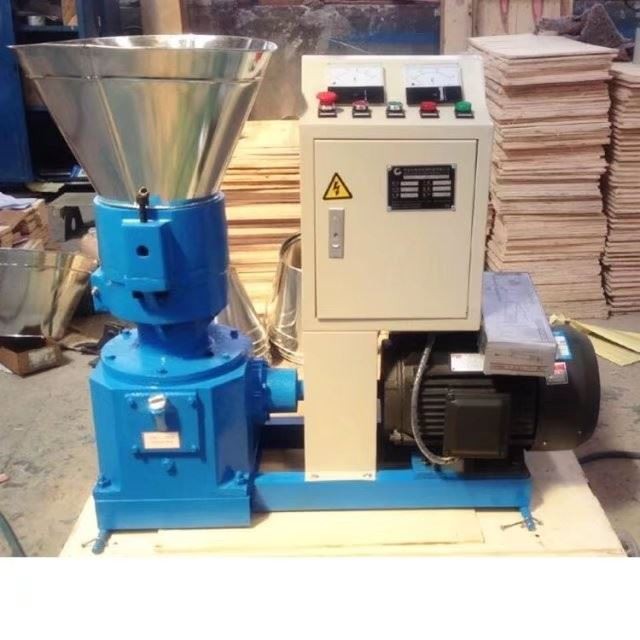


500-1000 kg/h Animal Feed Production Line for Zimbabwe
Send Inquiry
Product Details of500-1000 kg/h Animal Feed Production Line for Zimbabwe
Tianjin Mikim Technique Co., Ltd. is one of the most experienced manufacturers and suppliers of 500-1000 kg/h Animal Feed Production Line for Zimbabwe in China. If you're going to buy cheap 500-1000 kg/h Animal Feed Production Line for Zimbabwe made in China, welcome to get more information from our factory. All our products are with high quality and low price.
Quick answer
A 500-1000 kg/h animal feed line for Zimbabwe runs on one skeleton with two tiers. The 500 kg/h tier makes mash on a 33.5 kW machine sum and reaches 59.05 kW when the pellet block is added. The 1 t/h tier is quoted at the catalogue installed load of 62.5 kW on 10 x 3 x 6 m, or 65.5 kW on 12 x 4 x 8 m. Both take 380 V 50 Hz three phase power.

01
The 500-1000 kg/h animal feed line from intake to bagging
The plant is a five stage build on the mash tier and an eight stage build on the pellet tier. Both start at raw intake and end at a sewn bag. See the wider animal feed pellet line range for the same skeleton at other capacities.
Five stages with no die and no cooler
Cleaning comes first: an initial cleaner lifts straw, string and chaff, and a permanent magnet drum ahead of the grinding chamber catches tramp iron. Iron that reaches the chamber takes the rotor with it.
Grinding, batching by weight, mixing and bagging at 10-50 kg follow, with no thermal stage and nothing to screen.
A conditioner and a cooler behind the mixer
Four stages sit behind the mixer: conditioning, pelleting, cooling, screening. A crumbler sits between cooler and screen for poultry feed. Steam is outside the standard scope.
Stage
500 kg/h mash tier
1 t/h mash plus pellet tier
Raw intake, cleaning and magnet drum
included
included
Grinding to mash
22 kW
22 kW
Batching by weight
included
included
Mixing
250 kg per batch
500 kg per batch
Bucket elevator and conveying
included
included
Conditioning
not fitted
1.5 kW
Pelleting
not fitted
1-2 t/h, 1-12 mm die
Cooling
not fitted
1-2 t/h
Crumbling and screening
not fitted
1-3 t/h, grading screen
Weighing and bagging
10-50 kg bags
10-50 kg bags
Table 1: Shared skeleton and the pellet stage additions, stage by stage.

02
A hammer mill and mixer on the 500 kg/h tier
At 500 kg/h the plant is four motors and a weighing scale. The grinder is sized at 3-4 t/h against a 500 kg/h requirement, so the hardest material in the recipe sets the size. Two 250 kg batches per hour then carry 500 kg/h through the mixer.
The grinder on this tier is a water drop hammer mill on a 560 mm rotor turning at 2950 rpm, driven at 22 kW, sized 3-4 t/h through the screen, with a body of 1430 x 860 x 1000 mm. The rotor diameter and the 2950 rpm are the two figures that explain the rate: a 560 mm rotor carries enough hammer tip speed to hold 3-4 t/h on a 22 kW motor without a second pass.
Workstation
Machine
Model
kW
Intake and cleaning
Initial cleaner
line item
-
Iron removal
Permanent magnet drum
line item
-
Grinding
Water drop hammer mill, 3-4 t/h
SFSP56X36
22
Batching
Batching bin on load cells
line item
-
Mixing
Double shaft paddle mixer, 250 kg per batch
SSHJ-0.5
5.5
Conveying
Bucket elevator
TDSG10-25
1.1-1.5
Bagging
Weighing and bagging scale, 10-50 kg
DCS-Z-W-50
4.5
Machine sum
33.5
Table 2: A tier equipment list, 33.5 kW, taken at 1.5 kW on the elevator.

Every figure in that table is the nameplate of one machine: 22 for the grinder, 5.5 for the mixer, 1.5 at the elevator, 4.5 for the bagging scale. 33.5 kW is their sum, and it is the figure a generator, a breaker and a cable are sized against on this tier.
A batch mixer sized to 250 kg is the correct match; a larger one costs money and mixing quality together. With no die wear, no cooling and no steam, it is the cheaper build per tonne.
03
A Ring Die feed pellet making machine on the 1 t/h pellet tier
The 1 t/h tier keeps the 22 kW grinder, doubles the mixer to 500 kg per batch at 11 kW, and adds the pellet block: a 1-2 t/h ring die machine at 22 kW with a 0.55 kW feeder and a 1.5 kW conditioner, a counterflow cooler at 1.5 kW, a crumbler rated 1-3 t/h and a grading screen.

Machine sum, 500 kg/h build with the pellet block. Add the nameplates station by station: 22 + 5.5 + 1.5 + 4.5 = 33.5 kW for mash, then 22 + 0.55 + 1.5 on the press and 1.5 at the cooler = 59.05 kW with pelleting on. That is what the machines draw, and it is how each starter and each local cable is sized.
Catalogue installed load, 1-2 t/h build. The published commercial line is 62.5 kW on 10 x 3 x 6 m as Option 1, and 65.5 kW on 12 x 4 x 8 m as Option 2, for 2-3 operators on a 1-12 mm pellet band. That is a line figure for a published build: control cabinet, dust-collecting fan and every drive on the skid, taken as one number. It is the figure a site supply, a main breaker and an incoming cable are sized on, and it is not the sum of the rows below.
Workstation
Machine
Model
kW
Intake and cleaning
Initial cleaner
line item
-
Iron removal
Permanent magnet drum
line item
-
Grinding
Water drop hammer mill, 3-4 t/h
SFSP56X36
22
Batching
Batching bin on load cells
line item
-
Mixing
Double shaft paddle mixer, 500 kg per batch
SSHJ-1.0
11
Conveying
Bucket elevator
TDSG10-25
1.1-1.5
Conditioning
Conditioner on the press
SZLH-250
1.5
Pelleting
Ring die pellet machine, 1-2 t/h, 1-12 mm
SZLH-250
22 + 0.55
Cooling
Counterflow cooler, 1-2 t/h
SKLN11x11
1.5
Crumbling
Pellet crumbler, 1-3 t/h
LG-15*80
-
Screening
Grading screen
line item
-
Bagging
Weighing and bagging scale, 10-50 kg
DCS-Z-W-50
4.5
Line installed load
62.5 (Option 1) / 65.5 (Option 2)
Table 3: B tier equipment list, per-machine nameplate in the last column and the catalogue line figure on the total row.

The footprint is 10 x 3 x 6 m on Option 1: intake and grinding at one end, the mixer above the press, cooling and screening at the other, bagging at floor level. Option 2 on 12 x 4 x 8 m stacks the same stations on two levels and buys working room, not rate.
The two figures do not add to each other, and no reader should force them to. A row sum counts the drives listed on this scheme; the catalogue figure counts the drives on the published build plus the cabinet and the dust fan. One sizes a starter, the other sizes the incoming supply.
Four dies and mash at 12 to 20 percent moisture
Three facts about the press decide how this tier runs week to week, and all three are checkable on the specification rather than in a photograph.
- Automatic lubrication. One system oils the rollers, the main shaft, the gear and the bearings on a cycle, so the operator's round carries no grease gun and a missed shift does not become a scored shaft. - Four die sizes as standard. 6, 8, 10 and 12 mm come as the standard set. The band the press works is 1-12 mm, so a 3 mm crumble die or a 4 mm starter die is a die order, not a machine change. - Entry condition. Material reaches the die ground to a meal at 12 to 20 percent moisture. Coarse mash, or mash below 12 percent, does not form a pellet on any die in the set.
The moisture figure is the one buyers skip and the one that decides the afternoon. Dry mash polishes the die face, then blinds the holes, and the press reads the fault as a blocked die rather than a wet mixer. A line specified with a moisture check at the mixer discharge and a water line to the conditioner keeps the 1-2 t/h rating reachable.
Bagging closes the tier: 10-50 kg per bag, 200-300 bags per hour, 0.1 percent static and 0.2 percent dynamic accuracy, on a 4.5 kW scale fed at 380 V 50 Hz. The 25-50 kg bagging and sewing station turns a good pellet into a sellable bag.
Want both builds priced side by side? Send the slab size and ration list.
04
Which mixer suits your tier, 250 kg or 500 kg?
The choice between the two tiers starts at the mixer discharge, not at the grinder. Both schemes share the 22 kW grinder, the cleaner, the magnet drum, the batching scale and the elevator, and the hammer mill behind the 22 kW grinder is the same on both. Three things differ: mixer size, pellet stages and load.
Mixer size follows the tier: 250 kg per batch at 5.5 kW, or 500 kg per batch at 11 kW. One mixer cannot cover both. Everything ahead of the mixer is bought once, at one size, whichever tier is ordered, which is what makes the smaller build a stepping stone rather than a dead end.

Choosing between the tiers
Take 500 kg/h when every bag leaves as mash and the order book fits inside 500 kg per hour. Take 1 t/h when one product must be pelleted, when poultry is on the list, or when bagged feed travels more than a day before it is eaten.
05
Output rate for poultry, cattle, sheep and pigs
The kg/h figure is a plant figure, not a machine figure, and one number for every feed type is how a plant misses its first order.
- Mash, any species. Set by the batching scale and mixer cycle: 250 kg or 500 kg per batch. - Cattle, sheep and goat. Set by the press at 1-2 t/h through a 1-12 mm die, run at 6-8 mm. - Poultry. Set by the crumbler and grading screen at 1-3 t/h, because crumble needs a second reduction. - Cooling, all pelleted species. 1-2 t/h, whatever die is fitted.
Feed type
Pellet form
Stage that caps the rate
Figure
Mash, any species
none
batching scale and mixer
250 kg or 500 kg per batch
Cattle, sheep, goat
6-8 mm whole pellet
ring die, then cooler
1-2 t/h
Pig
whole pellet, die hole inside the 1-12 mm band
ring die, then cooler
1-2 t/h
Poultry
crumble
crumbler and grading screen
1-3 t/h
Table 4: Stage that caps output for each feed type on the same line.

06
Cleaning the line between cattle and poultry
A single line of this build runs poultry, pig, goat, cattle and sheep safely, and it does so without a second mixer or a second press. All five species are covered when the changeover is a cleaning task and not a settings task: the die, the crumbler gap, the conditioner water and the cleaning order change, not the machines.
Cattle before poultry, never the reverse
The hard direction runs from cattle down to poultry: a ruminant ration carrying a liquid binder and urea leaves a film with no place in a poultry batch. So run the sequence from ruminant to poultry.
1. Run the line empty until mixer, elevator and conveying line discharge clean. 2. Brush the mixer shell, shaft seals and discharge door, then open the elevator boot clean-out and the conveying end plate. 3. Change the die if the hole size changes. That is a die change, not an adjustment. 4. Reset the crumbler roll gap, or lift the rolls clear for a whole pellet. 5. Set conditioner water for the new ration and check the first charge by hand. 6. Return the first bag to the mixer, and mark it.
Residue hides in the mixer corner and elevator boot
The mixer is the first residue point and the one buyers underestimate. A 500 kg shell has a floor a brush reaches and a corner under the discharge door that it does not.
The elevator boot is the second: mash packs in and stays for weeks, which is how a poultry batch carries a cattle smell without a machine having failed. The conveying line is the third, since a bolted end plate makes a closed volume.
Urea carry-over after a cattle ration
Urea carry-over shows as a softer, darker pellet and a smell in the bag. Binder carry-over shows as a pellet that drags in the die and smears on the cooler deck. Neither is fixed by a purge charge and hope.
Changeover in one line
A species change is one full clean plus three set points. Clean the mixer corner, the elevator boot and the conveying end plate. Reset die, crumbler gap and conditioner water, then send the first bag back to the mixer.
07
Starting the motors on a 380 V 50 Hz supply
Zimbabwe industrial power is 380 V, 50 Hz, three phase, and both tiers are built for it. What changes is the incoming supply: 33.5 kW on the 500 kg/h mash tier, 59.05 kW on the same tier with pelleting, and 62.5 kW on the catalogue 1 t/h build.
Every motor gets its own starter in the cabinet, with thermal overload, phase failure protection and a stop circuit that drops the line. Start order runs from the back forward: bagging, cooling, press, mixer, grinder last, so the grinder never starts against a full elevator.
Motor
500 kg/h tier, mash kW
500 kg/h tier, with pellet block kW
Grinder
22
22
Mixer
5.5
5.5
Elevator
1.5
1.5
Ring die main drive
-
22
Ring die feeder
-
0.55
Conditioner
-
1.5
Cooler
-
1.5
Bagging scale
4.5
4.5
Machine sum
33.5
59.05
Table 5: Machine nameplates on the 500 kg/h build, with and without the pellet block. The 1 t/h build is quoted at the catalogue installed load, 62.5 kW as Option 1 and 65.5 kW as Option 2.
The cabinet arrives built and tested; incoming cable and trays sit on the site side.
08
The factory gate under EXW, the ship under FOB
Inland trucking and the export file stay with the buyer
Under EXW the machines are collected at the factory. Inland transport, export clearance, terminal handling and loading become the buyer's own work, and risk transfers at the gate.
FOB lifts the crate over the rail
Under FOB the offer carries the crates to the named port, clears them for export and lifts them on board. Risk passes with the cargo on the vessel, and the two hardest steps for a first import are gone.
Foundations and incoming cable stay outside
- Foundations, plinths and anchor bolts - Incoming power cable, main breaker and site cable trays - Steam boiler and steam piping - Spare parts beyond the recommended kit - Installation labour and travel for the commissioning engineer - Duty, destination port charges and the inland leg to the site
Port and quote boundary
The plant is the same through either port. Beira shortens the road leg; Durban widens the sailing choice. EXW stops at the factory gate and FOB stops on board at the named port. Foundations, incoming cable, boiler, installation travel and the inland leg stay outside both, and those five lines turn a cheap offer into an expensive project.
9
Commissioning the press and training the operators
The line runs with 2-3 operators per shift. A second shift doubles the bags through the same hands.
Commissioning runs in a fixed order: no-load run of every motor, a load run on mash, die warm-up, first pellet run, first bagged pallet. Nothing is signed off before a bag is weighed on the buyer's scale.
Training covers four items: die change with its torque sequence and gasket check; conditioner water for the ration in front of the operator; first-bag judgement, meaning what a good pellet looks and breaks like; and daily lubrication plus the weekly elevator boot check.
Warranty covers machines against manufacturing defect. Dies, hammers, crumbler rolls and belts are consumed by tonnage, not calendar. Foundations and the building stay with the buyer.
10
FAQ
1
Can the 1 t/h Ring Die chicken feed making run mash and pellet on the same day?
Yes. The 500-1000 kg/h animal feed line for Zimbabwe shares its front half, so the difference is whether the pellet block runs.
2
How many 10-50 kg bags per hour can the packing station fill?
200-300 bags per hour at 10-50 kg per bag, 0.1 percent static and 0.2 percent dynamic accuracy, on a 4.5 kW weighing and bagging scale.
3
Which port gives the shorter inland leg, Beira or Durban?
Beira, on the shorter road leg into Zimbabwe; Durban carries more sailings. Both are quoted FOB, with the inland leg on a separate line.
4
Can one mixer cover a 250 kg batch and a 500 kg batch?
No. The 500 kg/h tier uses 250 kg per batch at 5.5 kW, the 1 t/h tier 500 kg per batch at 11 kW.
5
Does the 1 t/h pellet scheme need a steam boiler?
Not as standard. The 1.5 kW conditioner is mounted on the press and ships with the machine, with a 0.55 kW feeder ahead of it. A boiler is a line-external item.
6
What sits outside an EXW price that FOB Beira or Durban covers?
EXW stops at the factory gate. FOB adds inland transport, export clearance and loading on board. Neither covers foundations, cabling, a boiler, destination charges or duty.
7
How is a species changeover handled without losing a shift?
Clean the three residue points, reset die, crumbler gap and conditioner water, then purge and check the first charge by hand.
Send the ration for each species and the tier you need. The reply comes back as a scheme-by-scheme scope with the load per tier, die sizes per ration, and the offer written to Beira or Durban.
Hot Tags: 500-1000 kg/h Animal Feed Production Line for Zimbabwe, China, manufacturers, factory, cheap, low price, made in China, Food Household Pellet Machine, Small Pellet Mill, Animal Feed Processing Machine, Rabbit Feed Granulator, Small Feed Poultry Pellet Machines, Homemade Pellet Mill
Send Inquiry
