
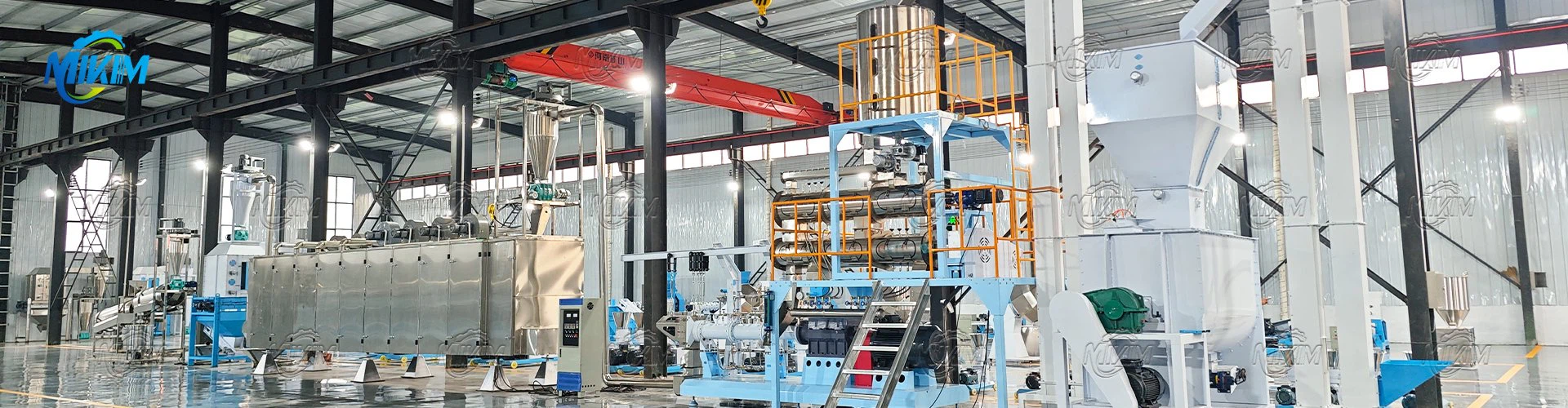
First, clarify the core principle: when using a fish feed pellet processing machine to produce animal feed, the selection of the machine must be "precisely matched to the type of livestock and the feed formulation."
content
For poultry feed such as chickens and ducks, it is recommended to choose a flat die pellet mill (small) or a ring die pellet mill (medium to large). These machines produce pellets with moderate hardness and uniform size, suitable for the pecking habits of poultry. Small flat die pellet mills are suitable for family farms, with a capacity of 50-200 kg/hour; ring die pellet mills are suitable for large-scale poultry farming, with a capacity of 500-1000 kg/hour and a high pellet formation rate. If producing chick feed, it is necessary to use a grinder of 40 mesh or higher, and a small extruder can be used beforehand to process corn raw materials to improve feed digestibility.
For pig feed, the selection of a pet food processing machine should be based on the growth stage: Piglet feed requires soft, easily digestible pellets, so a small ring die pellet mill is recommended, used in conjunction with an extruder-first, the soybean meal and corn are cooked in the extruder before pelleting to avoid overly hard pellets damaging the piglets' digestive system. Finishing pig feed requires higher hardness, and a regular flat die pellet mill is sufficient. The extrusion pressure can be appropriately increased to increase pellet density and reduce breakage during transportation. Furthermore, pig feed has a high protein content, so the moisture content should be controlled at 13%-16% when mixing raw materials to prevent clumping during pelleting.
For ruminants such as cattle and sheep, the focus is on producing straw and forage pellets. A large flat die pellet mill or a straw-specific pellet mill is recommended. These machines are more adaptable to coarse fiber raw materials and can effectively process harder materials such as straw and hay. A pre-extruder is unnecessary for ruminant feed, as cooking coarse fiber raw materials is not beneficial for ruminant digestion and would only increase costs; however, attention should be paid to the particle size of the raw materials (straw should be crushed to 2-3mm) to ensure good pellet formation.
For aquatic animal (fish, shrimp) feed, using a floating fish feed pellet making machine is quite difficult because aquatic feed requires pellets with strong water resistance and stable sinking. If you need to produce aquatic feed, it is recommended to choose a small fish feed pellet extruder (with a cooking function), or a combination of an extruder and an aquatic pellet mill. The extruder first cooks the raw materials, improving the feed's water resistance and digestibility, and then the aquatic pellet mill shapes the pellets, ensuring they don't easily disintegrate in water. In summary, choosing the right pellet mill is the core prerequisite for using it to produce animal feed. Only by combining this with the needs of aquaculture and the synergistic use of an extruder can high-quality feed be produced.
Related equipment


about Us
Customer visit

Certificate of Honor

FAQ
1. What is the price of the small fish feed maker machine?
The price ranges from approximately $1,500-$55,000
2. Do you provide maintenance services for your customers?
Yes, we offer comprehensive after-sales maintenance services to our customers.
If you would like to learn more about MIKIM machinery, please contact us. We offer one-stop service and welcome your inquiries!!!